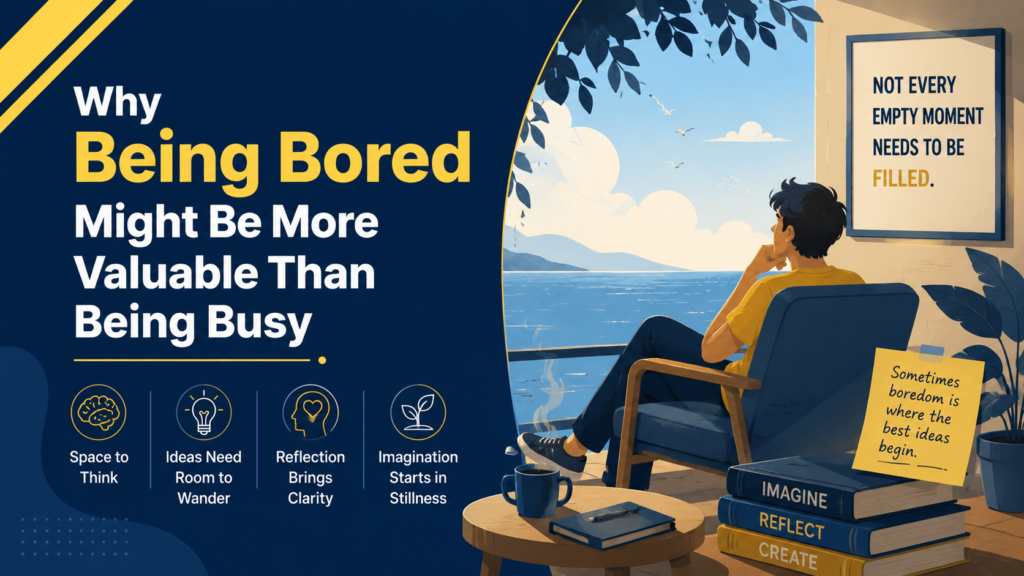
For years, modern society has sold us a simple idea:
Being busy means being productive.
The fuller your calendar, the more successful you appear. The more tasks you complete, the more valuable your time seems. Somewhere along the way, silence became uncomfortable, free time started feeling unproductive, and boredom quietly earned a reputation as something negative.
But what if we have been looking at boredom the wrong way?
This question recently resurfaced through a thought-provoking perspective shared by Ajay Srinivasan, challenging a belief that has become deeply embedded in modern lifestyles — the assumption that boredom is a problem that needs immediate fixing.
In reality, boredom may not be something to avoid.
It may actually be one of the most valuable mental states we experience.
The World Has Become Addicted to Constant Activity
Take a moment to observe daily life.
A quiet five-minute gap during the day immediately leads people to check their phones.
A free evening often turns into endless scrolling on social media.
Weekends that were once meant for rest now become packed with schedules, obligations, and constant stimulation.
Modern culture has normalized one dangerous idea:
Every moment must be occupied.
From childhood, people are conditioned to believe that idle time is wasted time.
Children hear the familiar phrase every summer vacation:
“I’m bored.”
Parents immediately begin looking for ways to fill that boredom with activities, entertainment, classes, or screens.
Adults do exactly the same thing.
The difference is simply better technology.
As Ajay Srinivasan highlights, society has developed an almost automatic instinct to eliminate boredom before it even has the chance to serve a purpose.
Why Boredom Creates Space for Creativity
One of the biggest misconceptions about creativity is believing great ideas happen during intense productivity.
In many cases, the opposite is true.
Creative thinking often emerges when the brain finally has room to wander without immediate demands competing for attention.
This explains why people frequently experience breakthrough ideas while:
- Taking long walks
- Sitting quietly without distractions
- Traveling alone
- Staring out of a window
- Spending time away from digital devices
When the mind is not occupied solving immediate problems, it begins connecting ideas in unexpected ways.
This mental wandering creates space for innovation.
The modern obsession with constant activity often prevents this process entirely.
Silence Allows Us to Think More Clearly
Productivity culture encourages people to focus on doing more.
Rarely does it encourage people to think more deeply.
There is an important difference.
Constant stimulation creates mental noise.
Notifications, meetings, deadlines, emails, social media, and endless digital content keep the brain permanently occupied.
The result?
People stay busy but often lose clarity.
According to the perspective shared by Ajay Srinivasan, boredom can actually serve an important psychological function.
It slows external distractions enough for internal thinking to begin.
And sometimes clarity only arrives when the world finally becomes quiet.
Why Children Understand Imagination Better Than Adults
Children offer one of the best examples of how boredom can become valuable.
When left without immediate entertainment, children eventually begin creating games, inventing stories, imagining scenarios, and engaging with their own creativity.
Imagination begins filling the empty space.
Adults, however, rarely allow themselves the same opportunity.
The moment boredom appears, people instinctively reach for digital distraction.
Streaming platforms.
Social media feeds.
Short-form videos.
Constant consumption has replaced quiet thinking.
As a result, many adults slowly disconnect from the very creativity they once naturally possessed.
The Problem with Always Optimising Life
One of the defining characteristics of modern culture is optimization.
Every hour needs measurable output.
Every habit needs efficiency.
Every task needs productivity.
This mindset has obvious benefits in professional environments.
But when life becomes permanently optimized, something important disappears.
Mental breathing room.
The human brain was never designed to function under continuous stimulation without pause.
Rest is important.
Silence is important.
Unstructured time is important.
And boredom may simply be the brain demanding space to reset.
This is one of the strongest underlying messages in the reflections shared by Ajay Srinivasan.
What Happens When We Stop Running From Boredom
The next time boredom appears, the instinctive response is usually distraction.
But perhaps there is another option.
Instead of filling every quiet moment, allow the mind to stay there for a while.
Observe what thoughts begin surfacing.
Notice what ideas emerge naturally.
Pay attention to what the mind has been unable to process while constantly occupied.
Sometimes boredom is not emptiness.
Sometimes it is the beginning of reflection.
And reflection often leads to clarity.
Final Thoughts
Modern life has convinced people that being busy is always better than doing nothing.
But history, psychology, and creativity suggest otherwise.
Some of our best ideas arrive not during periods of intense activity, but during moments of stillness.
Boredom gives the mind permission to wander.
Reflection helps people understand themselves more clearly.
And creativity often begins exactly where distraction ends.
The perspective shared by Ajay Srinivasan reminds us of something simple yet powerful:
Not every empty moment needs to be filled.
Sometimes doing less allows the mind to do more.
Perhaps boredom has never been the problem.
Perhaps it has quietly been one of our most underappreciated opportunities.